Read more ->


 12 Min
Agents reason and act at a speed no team can match; they book, buy, negotiate and reply while we sleep. Who is the agent acting for, and how can anyone on the other side know? Read on.

Domains, DNS and certificates are the stage crew of the internet: invisible for as long as the show takes place on the main stage, and noticed the moment the lights go out. As AI agents start to book, buy and negotiate on people’s behalf, that crew is about to matter even more.
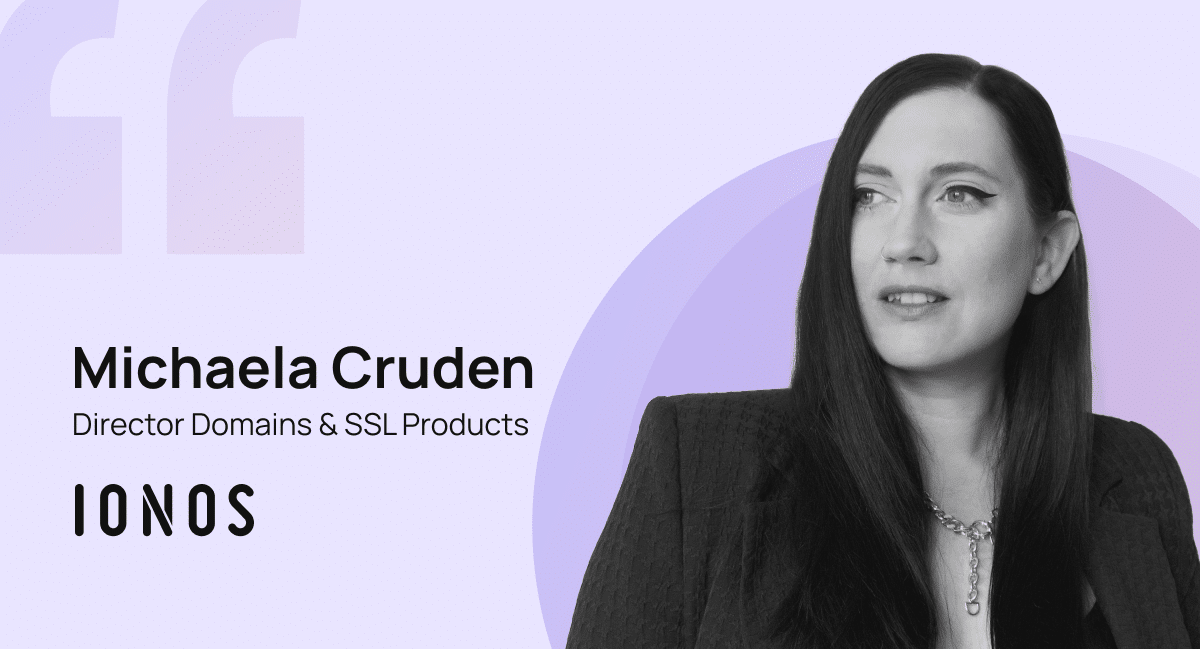
Our guest is Michaela Cruden, who leads Domains, DNS and SSL across IONOS Group. She started her career on the registrar side, worked in registry land both as the lead of an RSP and in channel management of a registry operator, and has now looped back to represent a registrar again at IONOS Group. She was also the first guest of this series, back in 2021 (read our first interview together) and it is a full circle moment for all of us.
Read on for our conversation with Michaela about the domain paradox, a silent film she loves from 1927, protecting what you own when agents hold the keys, the 2026 new gTLD round and what it takes to make a life in this industry.
They are less different than they look from the outside. While the brands vary in market focus, in price positioning and in which product leads the story, underneath them sits fundamentally the same purpose: giving small businesses the tools they need to make a life online. InterNetX is the outlier as a wholesale registrar, serving the resellers and platforms who in turn serve everyone else.
Managing domains, DNS and certificates together follows from how customers actually experience them. Think of them as the stage crew of the internet. Dressed head to toe in black, moving in the shadows, invisible for as long as the show takes place on the main stage. There is little fame in being the crew, but if one of them misses a cue, say a certificate that expires on a Sunday afternoon while two teams each assume the other had it covered, the whole set dramatically comes crashing down mid-scene. Nobody has ever left a theatre humming the lighting cues, but they notice the moment the lights go out. The customer never sees three departments fail. They just see their business go dark, so keeping them as one crew keeps everyone on cue, and it means fewer of those unintended dark Sundays.
Of the three, the domain is the one that anchors it all. Call it the domain paradox: it’s the first thing most customers buy and the last thing they think about. Or an inferiority complex? Who knows. A business will change its host, its platform, its agency and its logo over the years, and through all of it the domain stays. It’s your identifier, and the final name for that vision.
Call it the domain paradox: it’s the first thing most customers buy and the last thing they think about. Or an inferiority complex? Who knows.
Please allow me to take this on a tangent for a moment. There’s a title card from the silent film ‘Metropolis’ that has been playing on my mind lately on human agency in relation to the agentic web and I think there are some interesting parallels to pull from it. Fritz Lang debuted ‘False Maria’, the protagonist robot, in 1927 and she became the first great machine-woman of cinema. While some may still remember her aesthetic and haunting dance moves as viscerally as I do, which says more about my visual brain than I’d like, we forget that the shape of the storyline was pleading against her, and that its whole narrative rests on a single title card held up on screen: the mediator between the head and the hands must be the heart. Lang was warning that we could perfect our thinking, our making, our output and still misplace the organ in between, the one that makes us human. The century since kept the robot and lost the line, and the film was shelved ever after as a silent monster movie, alongside Nosferatu.
I think about that often when we talk about what it means to be human amidst the pace at which the agentic web is evolving and as we outsource more and more of our mundane life admin to tamagotchi-esque AI assistants. Agents reason and act at a speed no team can match; they book, buy, negotiate and reply while we sleep. Lang’s fundamental question still holds true a century later. It boils down to where the heart sits: who the agent is acting for, and how anyone on the other side can know.
That’s why I believe domains will matter more, not less. An agent sent out into the world has to carry something that says whose it is, and that anchor needs to be public, verifiable and stable across every platform the agent passes through. The domain name is the one identifier we already have that meets that test and a lot of current thinking is around how we keep the DNS fundamental to both the discoverability and identification layers of that system.
Imagine two agents arriving at the same booking system, each claiming to represent the same bakery. One is anchored to the bakery’s own domain; the other to an account on a platform the bakery stopped using last spring. Only one of them can be checked, and only one of them should be trusted. The deeper question for any business is whether its agents become principals or background processes. An agent anchored to your own name acts as you. An agent with no anchor acts as whatever platform happens to be hosting it that day.
Lang’s heart has to live somewhere, and I’d rather it lived in a domain name.
Two agents, one bakery
| – | Agent anchored to the bakery's own domain | Agent anchored to an old platform account |
|---|---|---|
| What the other side can check | A record published under the bakery's own name, resolvable by anyone, signed | Nothing beyond the platform's word that the account exists |
| Where the proof sits | In the DNS, public and independent of any one platform | In a database the bakery can neither see nor correct |
| If the business changes platform | The anchor moves with it. The claim still holds | The claim dies with the account, quietly |
| How it fails | Visibly. The record is gone, so the agent stops being trusted | Silently. The agent keeps making a claim nobody can test |
| Who carries the loss | The bakery, and it can act | The bakery, and it cannot |
| Role | Principal | Background process |
Having started my career on the registrar side and then having recently looped back again from registry land ten years later, I would say the core change is that customers have less patience for friction than they used to, and have far more fluency in what they expect from a registrar. A small business owner today has already wired up a payment provider, connected a shop to a marketplace and learned to live inside a dozen subscriptions, so they expect a domain to behave like everything else in their working life: instant, legible and connected before they’ve thought to ask. Resellers stand at the other end of the scale and want the opposite of surprise, which means clean APIs, steady pricing and renewals that arrive exactly when they were promised.
Underneath, both want the same quiet thing. They want nothing to happen. The domain is still there next year, the email keeps arriving, and the record goes live when we said it would. In this business, an uneventful year is the highest compliment a customer can pay.
The core change is that customers have less patience for friction than they used to, and have far more fluency in what they expect from a registrar.

Agents change portfolio protection in two directions at once: they will guard it, and they will open it. On the guarding side, they will tend portfolios, handling renewals, DNS changes and certificate rotation, and that’s welcome, because so many domain incidents begin with something small and human: an expired card, or a renewal notice sent to someone who left the company years ago. Machines are very good at not forgetting.
But every agent you hand the keys to is also a door, and the controls have to grow up alongside it. That means scoped permissions rather than master credentials, and a human hand on the changes that can’t be undone, transfers and nameserver changes above all. It means a registry or registrar level lock on the names that matter, DNSSEC so that what resolves is what you published, and a clear record of which agent did what, and on whose authority.
Attackers have agents too. Lookalike domains and phishing kits now arrive faster than any brand team can watch by hand, so vigilance has to be automated just to keep pace.
That the other side always looks easier from your own chair.
Registries tend to believe a registrar only needs to put the TLD on the shelf, and registrars tend to believe a registry only needs to make a better TLD. Both are misguided in the same way, because neither owns the customer outright. The registry owns the string and the registrar owns the relationship, and between them lies a space that belongs to nobody, the unowned middle, which is precisely where every domain business is won or lost.
When you move into the other chair, the same negotiation turns itself inside out. The demands you once thought unreasonable start to look a lot like fear, and the ones you used to make start to look a lot like habit.
The painful truth I’d tell registries now is that the shelf is full. A registrar’s storefront has room for a handful of extensions a customer will actually see, and every new one is competing with .com, the local country code and whatever the customer typed first. A discount on its own won’t earn that space; I said as much in our first interview together in 2021, and the shelf has only grown more crowded since. What earns it is a reason: an audience that already exists, and demand the registry has built with its own hands.
The unowned middle
| – | Registry | Registrar |
|---|---|---|
| Owns | The string | The end-user relationship |
| Tends to believe the other side only needs to… | put the TLD on the shelf | educate and drive demand |
| Owns the customer demand outright? | No | No |
Every name is a bet placed before anyone has asked for it. A new TLD is a wager that somewhere out there a group of people is waiting for a word to gather under, and that they’ll recognise it when they see it.
The extensions from 2012 that found their audience mostly had one before they launched: a community, a brand, a use that never needed explaining. The ones that struggled had a delegated string and a hope, and occasionally a very good mood board. Distribution is decided long before launch day. The channel is very good at converting interest, but it can’t conjure that interest out of nothing.
Registrars will be choosier this time round. In the last round many onboarded everything and promoted almost nothing, and the cost of integration was spread thinly across hundreds of TLDs that never sold in much volume. They’ll move quickly where the demand is real and let the rest prove themselves.
Every name is a bet placed before anyone has asked for it.
I’ve said before that this industry is a profoundly humanist project disguised as a technical one, and my view on it only gets firmer every year. Names exist because people needed the internet to be something they could remember, say aloud and trust. Underneath the protocols, it is still a story about language, transcending borders, belonging and who ultimately gets to be found down the rabbit hole that is the internet.
That matters for anyone coming in now. I’m biased because of my own fixation on existential thinking, but there isn’t a better moment to arrive and bring something beyond hard skills to the table. As the classic traits of someone working in technology start to be automated, the configuring, the reconciling, the endless checking, there is more room to step back and focus on the bigger picture. Some of it is abstract: what identity means when an agent can speak in your name. Some of it is very tangible. Country codes carry the weight of their countries, and as borders harden and regulation multiplies, decisions about who governs a namespace, where its data lives and who may hold a name are becoming geopolitical decisions. The people who can hold the technical, the political and the philosophical in view at once will be the ones shaping what comes next.
So learn how a name travels from registry to registrar to reseller to customer, but don’t stop there. Invest in the human skills: judgement, clarity, and the patience to sit in a room with people who want different things until you find the version everyone can live with. Build a reputation for caring about the mission of the community, and make sure it comes with being trustworthy and reliable, in the plainest human sense.
This is a very small industry, and we all change sides eventually. The registry you negotiate against today may be the one you work for in five years, and the person beside you in a policy session may be across the table from you sooner than you think. A base level of integrity is the most valuable thing you will ever carry between those chairs. If people trust you to act beyond your own narrow self-interest, you will never struggle to find people to partner with, build with, and help shape things with.
Keep looking up. I’m still working on it myself.