Read more ->


 13 Min
AI systems answer questions instead of sorting links. They recommend brands, not URLs, and people are clicking through to websites less and less. So what’s left of your own domain?

For twenty years, online visibility followed a simple equation: better rankings, more clicks, more customers. That chain is breaking apart. More and more often, the answer no longer comes from a list of results but from an AI system that summarises, names providers and recommends brands. Rankings are turning into mentions. Traffic is turning into presence. For millions of small businesses that have found their customers through Google so far, this shifts the very foundation of their digital operations.
For domain owners, this is more than a marketing debate. When reach is increasingly mediated by platforms and models, the question becomes what a business actually still owns online, and how machines recognise it in the first place. The domain is the reference point everything else is anchored to: website, email, directory listings, reviews. DNS, availability and load times are no footnote for the technical team. They help determine whether a business is even considered as a source.
To put all of this into perspective, we spoke with Daniel Wette, CEO and co-founder of rankingCoach. He has spent more than 20 years in online marketing for small and medium-sized businesses. rankingCoach operates in over 30 countries today and is integrated into the offerings of more than 40 hosting, telecommunications and technology partners, a vantage point that covers the end customer and the infrastructure behind them at the same time. The company is currently launching ado.ai, an agentic AI CMO: an AI agent that does not just analyse marketing for small businesses but carries it out independently.
Read on for our conversation with Daniel about domains as a brand foundation, the technical basis of visibility and what comes after the click.
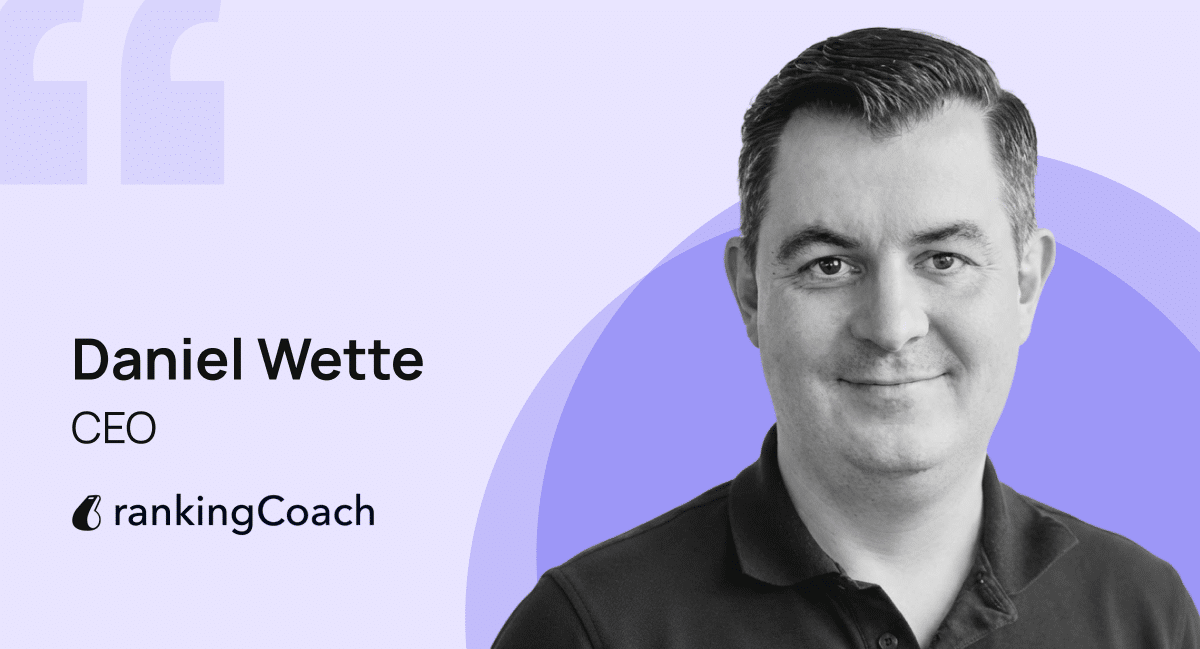
When I started out, the rule was: search marketing is done by the web designer or the agency, or by nobody at all. I know that world first-hand, because from 2004 onwards I helped build FAIRRANK into one of the largest German online marketing agencies for SMBs. The first turning point for me was realising there was another way. When we launched rankingCoach in 2014, the goal was to let small businesses take the most important things into their own hands, without an agency budget and without prior knowledge. And it works, because in local competition you do not need to win the SEO world championship. Doing two or three things better than the competitor next door is often enough to beat them in Google’s rankings. Hundreds of thousands of users doing exactly that have proven us right over the years.
Two things were overestimated above all. First, the endless Google updates, each of which was followed by the claim that SEO was dead. SEO never died, it simply changed. And second, voice search. “50% of all searches will be voice by 2020” was the famous forecast. Today you can see the result: Alexa, Siri and the rest are not really making headway even with AI, and a separate discipline called voice SEO never emerged.
The second major turning point is happening right now. There is one thing even the best do-it-yourself tool could never take off its users’ hands: the time they have to invest themselves. For the first time, AI can now also complete the tasks that previously required either an agency or your own hours. Not guiding, not explaining, but doing. I say that as someone who knows both sides, the agency side and the DIY side. It fundamentally changes the economics of marketing for small businesses, which is why we are deliberately taking the next step with ado.ai: from coach to colleague. ado.ai is designed as an AI agent that does not just recommend marketing tasks but carries them out independently.
As a direct ranking factor, the domain matters less than most people believe. Exact-match domains lost their shortcut effect back in 2012 with Google’s EMD update. But as a brand and trust signal it has never been more important, and that works on two levels: for people and, increasingly, for AI systems.
Brandable beats keyword. A domain like plumber-cologne-24.de wins neither clicks nor trust today, and an AI certainly will not recommend it. ccTLDs remain strong for local businesses because they signal proximity and commitment; .com belongs to international ambitions; new TLDs work well when the brand is managed consistently. With ado.ai, we deliberately chose a short, branded domain ourselves.
What AI changes: AI systems increasingly think in entities and brands, not just in URLs and keywords. The domain is the anchor an AI attaches every signal about a business to: website, reviews, directory listings, mentions. That is why my advice to every small business is one domain, one company name that is identical everywhere, no games with five domain variants. Consistency is the new keyword domain.
More than most people think, but not in the way they think. Technology rarely decides who ends up in first place. It very often decides who does not show up at all.
An expired certificate, broken redirects after a relaunch, a website that takes five seconds to load on mobile: that costs you crawling, then rankings, then customers. Content can be improved. A site that is technically unreachable is simply gone.
The most common blind spot, in my view, is not a single technical detail but the absence of monitoring. A small business website gets built once and then goes untouched for years. When something breaks, and eventually something always breaks, nobody notices because nobody is looking. All the business notices is that the phone rings less often. That is why we treat monitoring at rankingCoach as a core function, not an add-on.
For hosting providers, incidentally, this is a real opportunity: whoever handles certificates, availability and technical quality properly as part of the package takes the most dangerous work off their customers’ hands, namely the work they would never see themselves. Monitoring, structured data and AI-powered answering services are the obvious building blocks here.
First a reality check, because it tends to get lost in the GEO discussion: Google still dominates the market, with around 90% search engine market share and more than five trillion searches a year, which is roughly 14 billion a day. ChatGPT now processes around 2.5 billion prompts daily by its own account, but only a fraction of those are searches at all. And when it comes to the traffic that actually arrives on business websites, AI referrals are still far below 1% according to clickstream analyses by Semrush, while Google remains the dominant channel. Anyone claiming today that Google is irrelevant is selling something.
But here is the point: the trend and the direction are unmistakable. AI usage is growing dramatically faster than anything else, and it is also eating its way into Google search itself. AI Overviews appear for an ever larger share of queries, and a Pew Research study from 2025 shows that users click on a result in only about 8% of cases when an AI summary is present, compared with 15% without one. So the click rate roughly halves, and the decision increasingly happens inside the answer itself. And there is no page two in an AI answer. That is exactly what you need to prepare for now, while it is still a head start and not a catch-up race.
Concretely for SMBs: the AI assembles its answer from reviews, directory listings, structured data and the content of your own website. Consistent business data everywhere, actively managed reviews, content that answers real customer questions: that is GEO for small businesses. The hype is the circus around it, the “secret GEO formulas” and the agencies selling an entirely new discipline. From where I stand, 80% of GEO is what good local online marketing always was. The penalty for skipping it just gets harsher.
What has changed is the workload: doing two or three things better than your neighbour is still enough, but the list of those things has grown longer. Which is exactly why what used to be legwork now has to run automatically in the background.
| – | Classic SEO | AI answers and GEO |
|---|---|---|
| Role of the domain | Address of the website and one ranking factor among many | Anchor of the entity: the point where all signals converge |
| What counts in the name | Matching keywords, exact match as a shortcut | Brandability, brevity, recognisability |
| Extension | Mainly a geographic and language signal | Additionally a trust signal for humans and machines |
| Multiple domains | A chance at additional rankings | Dilutes the entity signal |
| Role of technology | One ranking factor among many | A precondition for being considered a source at all |
| Measure of success | Position in the list of results | Mention in the answer |
| Second chance | Page 2 | Does not exist |
Both are right, they are just talking about different functions of the website. As a recipient of traffic from informational searches it really is losing ground: the AI absorbs those clicks and they do not come back. As a source, on the other hand, it matters more than ever. AI systems have to take their answers from somewhere, and your own website is the only place where a business decides for itself which facts about it exist in the world: services, specialisation, prices, opening hours. On top of that come all the other places a business appears: directories, review platforms, social media profiles. rankingCoach makes sure this data is identical and up to date everywhere, because an AI aggregates all of these sources at once.
And with agentic AI, the website as your own asset becomes more important again. A concrete example: I ask an AI agent to find a wedding photographer in a particular city. The photographer who does not just have a few photos on the site but describes their services in detail, publishes prices and perhaps even availability and has actively gathered plenty of reviews gives the agent a complete picture it can match directly against what its principal asked for. The photographer with the thin website forces the agent to send out enquiries first and may drop out of the selection entirely. Comprehensive, honest content is not a nice-to-have for the agent, it is the selection criterion. Everything else is rented land.
Social profiles, marketplaces, AI chats: someone else makes the rules there, and those rules change without warning. The domain and the website are the only thing a small business truly owns. What changes is the role: less glossy shop window, more machine-readable body of facts, plus the place where the appointment, the call or the purchase ultimately happens.
Our experience from more than 30 markets in one sentence: consistency beats cleverness. Sound means one strong core brand and one clear address per market. So ccTLDs where local trust drives the purchase decision, or language directories under a single main domain where efficiency counts. Add clean hreflang and, above all, the same entity everywhere. Same name, same data, linked profiles, so that search engines and AI systems understand it is all one company.
What no longer works: dozens of keyword domains posing as branch offices. That dilutes exactly the entity signal you need today.
One topic that tends to be underestimated in multi-market strategies is reputation and security. Anyone operating internationally should own the most important generic extensions and the ccTLDs of their active markets for their own brand name, even if they never use them actively and only redirect them to the main domain. There are plenty of actors who use scam and phishing methods to exploit precisely the trust people place in a brand. A deceptively genuine-looking domain under a different extension is all it takes. Above a certain company size, a domain blocking service is also worth considering: it largely blocks the brand name for third parties at registry level across hundreds of extensions. The conclusion is simple: build a global brand, register nothing but the .com domain and ignore the rest, and you risk trademark problems and reputational damage caused by fraudsters, damage that ends up attached to your own brand.
And local visibility without a map pack? An AI answer is essentially an aggregation: reviews, directories, mentions, website content. Local visibility now means being present and consistent in those sources instead of optimising for a position on a map. That is good news for quality, by the way: a business with excellent reviews will be in a better spot than one with the better SEO trick.
Agentic AI. The step after “AI answers questions” is “AI completes tasks”: an agent no longer just pulls up three roofers, it collects quotes and proposes an appointment. Domain owners and hosting providers should expect a growing share of the requests hitting their websites to come from machines acting on behalf of customers. That calls for current, structured, machine-readable data, reliable availability and processes that can be triggered or booked digitally.
And once more and more enquiries arrive from AI agents, AI will answer on the business side too. No trades business is going to handle twenty agent enquiries a week manually. Its own AI will take that over. That way the customer’s agent gets a qualified answer immediately, and the business does not lose a job because an enquiry sat around for two days.
You can already see the scale of that potential on the phone. In our customers’ call tracking, we have seen that small businesses frequently miss 30-40% of incoming calls because nobody is free to pick up. A British study even found 47% of first-time calls going unanswered. Every one of them can be a lost job. An AI phone assistant such as the one IONOS offers can take those enquiries around the clock. In marketing, we are pursuing the same idea with ado.ai: an AI agent as a marketing colleague that takes on tasks and carries them out independently.
So my most important piece of advice for business owners is this: use the window. Over the next 24 months, adopting AI early can still create a real competitive advantage. Because the next visitor to a website may no longer be a person but an AI agent acting for one. And then the decisive question is no longer just whether Google can find my business. It is also whether a machine can understand my business, select it and interact with it.